What the adventure slider does to a song
One number from 0 to 100 decides how far a new song strays from what its genre is known for.
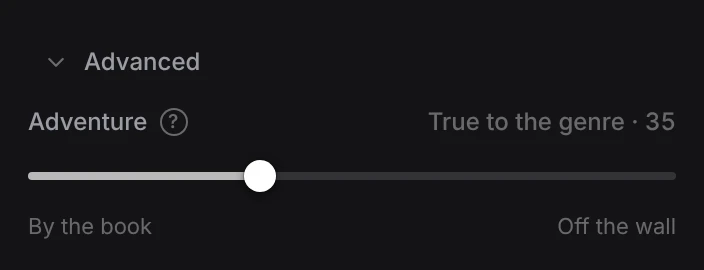
Every new song in Songcode is written with an adventure setting. It’s a number from 0 to 100, it sits first in Advanced in the Songcode Studio, and it starts at 35. Low numbers keep a song close to what its genre is known for. High numbers send it further away.
One prompt, five settings
Let’s ask for a synthwave loop with the same short prompt every time, “something for a long drive at night”, on Extra. Nothing is set besides the genre and a few different levels of adventure. Here’s what comes back.
| adventure | title | key | tempo | chords |
|---|---|---|---|---|
| 0 | highway neon dreams | b♭ minor | 102 | G♭, A♭, B♭m |
| 35 | sodium mile markers | f♯ minor | 115 | F♯m7, E7, Dmaj7, E7 |
| 35 | empty highway | e minor | 97 | Em, G, D, Am |
| 75 | night tollway | d♭ major | 89 | D♭, G♭ |
| 100 | roadlight | d♭ major | 89 | G♭, A, D♭, E |
0, by the book
This is synthwave as the genre’s fans would describe it. The chords climb six, seven, one in a minor key, a lift the genre has used since its first records. A big gated kit, a pulsing 8th-note bass, brass-like synth chords and a saw lead with a slide in its hook. Every choice is the one synthwave makes most often.
A setting of 0 still gives you a new song each time. The key, the hook and the title change from take to take. What stays put is the vocabulary.
35, true to the genre
Two takes at the default, because this is where the slider shows what it’s for. Both are clearly synthwave, and they don’t share a key, a tempo or a chord. The first moves every chord an 8th note early, so each change lands just ahead of the bar and the loop leans forward like a car pulling out to pass. The second is slower and plainer, with a shaker, a ride and rain under the whole thing.
75, adventurous
Now the song starts borrowing. It’s in a major key, which synthwave picks far less often than minor, and it sits on two chords for the whole loop. The kit is one of our more electronic ones, the lead is a whistle, and a musical saw comes in over the top. You can still tell it’s synthwave from the bass and the arpeggio, which is the idea: at 75 the song keeps enough of synthwave to be recognisable, and the rest is up for grabs.
100, off the wall
The genre is only where this one started. The chords jump G♭, A, D♭, E, each a third away from the last, so the loop never settles into a key the way the others do. The drums are a funk kit, the low end has a bassoon in it, a flute plays the lead and rain runs under it. Plenty of people would call this a bad synthwave song, and they’d be right. Turn the slider to 100 when the genre is a starting point and you want to see where it goes.
What the slider changes
The words beside the slider change as you drag it, and each range writes a different kind of song.
| setting | word | what you get |
|---|---|---|
| 0 to 15 | By the book | The chords, forms, grooves and sounds the genre is loved for. |
| 16 to 55 | True to the genre | Still clearly the genre, with its own key, chords and hook. The default is here. |
| 56 to 80 | Adventurous | Rarer chords, changed forms, a groove or a sound borrowed from another genre. |
| 81 to 100 | Off the wall | Odd meters, rare scales, strange hooks and beats from nowhere. |
The slider reaches the whole song: its key and tempo, its chords and form, its groove, its sounds and its hook. At a low setting each of those comes out as the genre usually has it. At a high one any of them can come from somewhere else.
Your prompt comes first
The slider only fills in what you leave open. Ask for a key, a tempo, a chord chart, a form or a melody with its notes and you get exactly that, at 0 or at 100. If you write “slow, in D minor, with a cello”, the slider decides everything except the tempo, the key and the cello.
The same goes for settings. A tempo or a key you pick in Advanced is yours, and the slider works around it.
It travels with the song
The setting is written into the song as a line of ode, next to the tempo and the key:
ode
title "sodium mile markers"
tempo 115
key f# minor
adventure 35%
The line records how the song was asked to be written. It changes nothing in the sound, and deleting it doesn’t change a note. It’s there so you, or anyone who remixes the song, can see where it came from. Double click the slider to put it back to 35.
The API and MCP take the same number as adventure, from 0 to 100, with the same default. The API docs have the details.
Why 35
We wanted a default where a song in any genre sounds its best: close enough to the genre that it’s clearly that genre, and far enough from its habits that two songs from one prompt sound like two songs.
So we wrote the same prompts, seven loops in different electronic genres and two full songs, at 0, 35, 50, 75 and 100, and listened to every one, marking each take twice: does it sound like its genre, and does it sound good. 35 came out on top. Seven of the nine songs we rated there passed both. At 0 it was four, mostly because the songs sounded alike and a little flat. At 50 it was six, at 75 two and at 100 none. The ratings at 100 aren’t a fault of the setting: an off-the-wall song isn’t trying to sound like its genre.
Nine songs a setting is a small set, and the default is one number we can move as more listening comes in. If you find a setting you like better, the Studio remembers where you left the slider for your next song.